Thursday, April 7, 2011

Experimental Films and The Spectator Experience


           As I watched the music video for “Her Morning Elegance” by Oren Lavie and Merav Nathan, I began to realize that the video is not just about a girl laying in bed as different stages happen. But it made me think of how much of our day comes natural to us. There are plenty of people today who have their regular morning routine, whether it is making coffee while checking your email or eating breakfast while watching television. I think many of us go on about our day without really thinking about what we are doing. We just know that it is part of our routine. Wake up, go to work, attend classes, study, and go to sleep to then do it all over again the next day. We know our routines so well that we could do it in our sleep. That is what this video kind of reminded me of. Some people get so caught up in their daily routines that they forget to really experience what life has to offer and next thing you know you missed it.
            I do believe that the YouTube generation views experimental films differently than before because we have they are more available to us then before. Anyone can post something on YouTube for the world to see and I think that’s allowed for experimental films to expand its audience. Also think the generation now views experimental films differently than before just because of how the film industry is today. Films that this generation see’s today is more about making people laugh or scaring people out of their seats. A lot of films today don’t necessarily allow the audience to think about any hidden meanings or how it made them feel. Audience today is expecting to be told what to think even through YouTube videos. Most of the videos we watch on YouTube is someone expressing their opinions but it has also allowed for our generation to exposed to different things all the time, which allows us to become more knowledgeable and curious in different subjects.

Thursday, March 3, 2011

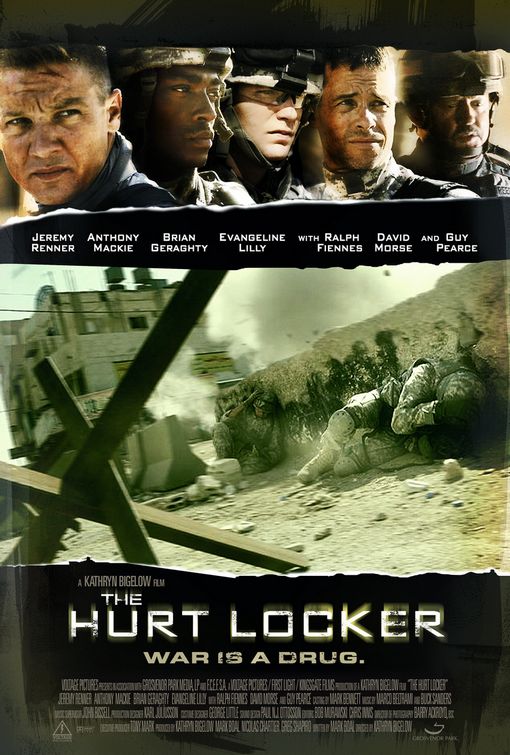
The Hurt Locker


The scene begins with a black screen contrasting with the white letters that say “ The rush of a battle is often a potent and lethal addiction, for war is a drug”. As the black begins to fade away the color of the sandy road arises. The camera continues this journey of a shaky endless road. The camera slowly begins to zoom out of the ground and into the chaos around this street. The audience can hear the sound of the cars honking and civilians yelling but it is through high angle shots that the audience can finally see what is happening. Scenes are constantly switching to keep up with the fast pace of the civilians and soldiers running.  It is through the point of view of the robot that the audience can see that the reason there is such chaos is because of bombs positioned in the middle of the street. Through medium close up shots the audience can connect with the American soldiers. The camera captures the movement of the city by using civilians and soldiers point of view shots. As the soldier begins to walk towards the bombsite through high angle shots it gives the audience a civilians prospective. As the soldier is walking back to safety, the other soldiers are attempting to keep themselves safe the movement of the camera begins to slow down. The camera slowly captures the explosion then switches to the rocks lifting off the ground, as well as the sand coming off a near by abandoned car. Compared to the fast pace from the beginning, the explosion almost seems to last forever. It is after this scene that the screen turns black.
            There are two predominant explosion scenes in this film. In these two scenes it is always a soldier from the squadron that is at risk of dying. In the opening scene described above, Sergeant Thompson runs away from the explosion and unfortunately never makes it. This frame shot is extremely slow and captures the movements of the different aspects in the film. In the other explosion, Sergeant James attempts to disarm a bomb that is strapped to a civilian’s body. In this scene when the explosion goes off, James looks back at the civilian. The explosion is also not prolonged through slow motion. Contributing to the idea that Sergeant James is more comfortable with the idea of death than the rest of the soldiers. Also in comparison is the fact that when Sergeant James opens his eyes, from his prospective, the camera shows a kite flying up in the sky. The kite in the sky can remind the audience of something joyful or a childhood memory. The form of this film allows the audience to have the opportunity to connect with the characters on a more personal basis than just viewing the movie as another stereotypical war movie.


Thursday, February 3, 2011

Shark in the Head


There are many prominent settings in the film Shark in the Head but a particular scene that stood out the most to me would be where the main character focuses on the newspaper. As the main character is focusing on the newspaper the camera zooms into the picture of a ribbon cutting opening ceremony giving the audience a first person perspective from the main character. We then see a small red ball appear onto the picture that begins to color the ribbon red. Then the red ball travels to a white background and begins to draw different figures; figures such as a sun, a volcano erupting, a chicken, and a car accident that is ultimately caused by the red ball in the middle. The background music complements what the red ball is drawing. For example, as the red ball is drawing the chicken the audience hears a chicken chirping and in the scene of the car accident we can hear the cars crashing and honking.  The sound of the cars honking and crashing along with the chicken could be in my opinion non-diegetic. This scene expresses the enigma that our main character is clearly broken away from reality and somewhat childlike. It proposes the idea of what exactly is real and what comes from our imagination in our lives. How much of what we know is real? The director of Shark in the Head deviated from Hollywood movies because Maria Procházková focused on a setting that elaborates on the idea of imagination. Procházková does this by creating scenes where the setting turns into cartoons symbolizing the main characters imagination. This particular scene does contribute to the visual themes of the film because it correlates with other scenes in the film such as the scene of the sidewalk with the chalk. Another example is the scene where the main character looks out into the street and imagines the faces coming at him.
This movie in my opinion through this scene is more focused on the style of the movie than the manner. This particular scene places a lot of emphasis on the props and editing of the movie. The scene simply focuses on the red ball that is drawing on the white screen. The audience can also notice that the only color that stands out is the red from the pill and the figures are mostly drawn out in black and grey. Throughout the film the camera actually focuses on the red pill a couple of times. At the end of the movie one comes to realize that the red ball we keep seeing is actually the main characters medicine. This is a perfect example of how the director connects the story behind the main character and the props, such as his medicine, in the movie.

Thursday, January 20, 2011

Bound by Haiti


In the documentary Bound by Haiti the story of two inspirational men is told about their struggles in the effort to save Haiti from its current state. John Bougher and Roman Safiullin capture the obstacles and crisis that Haiti finds itself in today. Through this documentary, the audience connects with the main characters American Aaron Jackson and Haitian John Dieubon. In their story, Aaron and John have not only formed a beautiful friendship but also work together to move Haiti in a positive direction. Aaron spends most of his time in the United States raising money thru his non-profit organization that works to de-worm the children of Haiti. Meanwhile, John spends most of his time in Haiti in charge of an orphanage with children who have no family and nowhere to stay as well as building a school to demonstrate that there is still hope for the people of Haiti. That one day they can move forward. The documentary also captures a moment of great tragedy when Haiti was struck by an earthquake with a catastrophic magnitude of 7.0Mw. This film demonstrates that there are still people who are determined to bring change into Haiti so that it can one day become a stronger more united Haiti. It is also a message to countries around the world that Haiti needs our help to move forward.

After the screening of the film, John and Roman voiced their opinions on the issues of how to execute scenes for their documentary and when to put subtitles so that the audience could understand John Dieubon. During the earthquake scenes, John and Roman strategically showed the chaos in which the country was in as well as the falling buildings and the dead people around the streets under the buildings. John and Roman were able to portray these scenes in a tasteful manner where it was not demeaning to those who had lost their lives.  


Sunday, January 16, 2011

Full Metal Jacket


In the review of Full Metal Jacket by Roger Ebert, Ebert does not provide a whole lot of the plot synopsis. Ebert mentions that the movie is about the Vietnam War. Ebert refers so a couple of scenes in the movie but does not go into depth to the point where it can spoil the movie for someone who has not seen it. Ebert provides some criticism toward the director and screenwriter of the film, Stanley Kubrick although he does consider it the best-looking war movie made on sets and stages. After reading this review, I wouldn’t necessarily be dying to see this movie. Although Kubrick does refer to important scenes, overall the review includes more negatives points than positive. Ebert did praise the character the gunnery sergeant and the tubby misfit, as Ebert would say, for their performances. He considers them to be the best performances of the film that never recovers after they leave. Ebert points out how Kubrick likes to show close up of the man glowering up at the camera insinuating that something may happen, ruining the suspense of the film. Ebert does an excellent job on emphasizing how Kubrick uses different angles of the movie to show the same scene and how that loses the audiences focus. Ebert also pointed out the fact that at the beginning of the movie there is a war/sex connection that is very noticeable. I had actually pointed that out myself while watching the movie. This review does indicate that Ebert is “literate” in the visual literacy of movies. In my opinion, Ebert reviewed the movie not just with a plot synopsis but went further into speaking about the films style and structure. Ebert also took into account other movies Kubrick has directed into account when reviewing this film.