
The scene begins with a black screen contrasting with the white letters that say “ The rush of a battle is often a potent and lethal addiction, for war is a drug”. As the black begins to fade away the color of the sandy road arises. The camera continues this journey of a shaky endless road. The camera slowly begins to zoom out of the ground and into the chaos around this street. The audience can hear the sound of the cars honking and civilians yelling but it is through high angle shots that the audience can finally see what is happening. Scenes are constantly switching to keep up with the fast pace of the civilians and soldiers running. It is through the point of view of the robot that the audience can see that the reason there is such chaos is because of bombs positioned in the middle of the street. Through medium close up shots the audience can connect with the American soldiers. The camera captures the movement of the city by using civilians and soldiers point of view shots. As the soldier begins to walk towards the bombsite through high angle shots it gives the audience a civilians prospective. As the soldier is walking back to safety, the other soldiers are attempting to keep themselves safe the movement of the camera begins to slow down. The camera slowly captures the explosion then switches to the rocks lifting off the ground, as well as the sand coming off a near by abandoned car. Compared to the fast pace from the beginning, the explosion almost seems to last forever. It is after this scene that the screen turns black.
There are two predominant explosion scenes in this film. In these two scenes it is always a soldier from the squadron that is at risk of dying. In the opening scene described above, Sergeant Thompson runs away from the explosion and unfortunately never makes it. This frame shot is extremely slow and captures the movements of the different aspects in the film. In the other explosion, Sergeant James attempts to disarm a bomb that is strapped to a civilian’s body. In this scene when the explosion goes off, James looks back at the civilian. The explosion is also not prolonged through slow motion. Contributing to the idea that Sergeant James is more comfortable with the idea of death than the rest of the soldiers. Also in comparison is the fact that when Sergeant James opens his eyes, from his prospective, the camera shows a kite flying up in the sky. The kite in the sky can remind the audience of something joyful or a childhood memory. The form of this film allows the audience to have the opportunity to connect with the characters on a more personal basis than just viewing the movie as another stereotypical war movie.
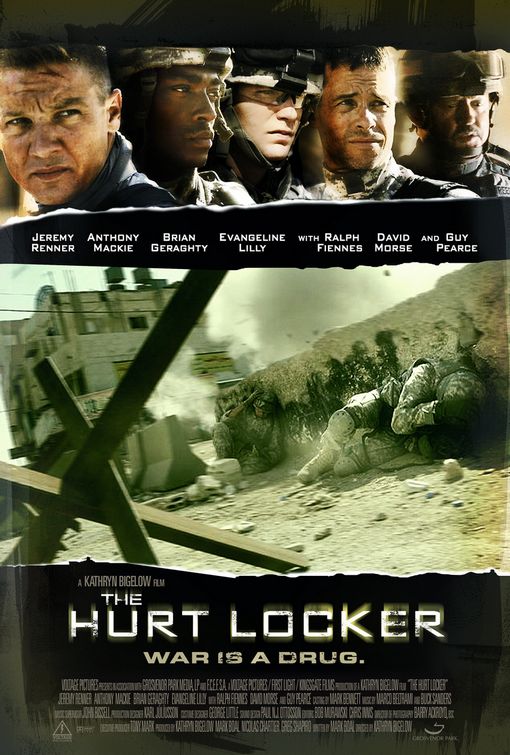

Another scene in the film, The Hurt Locker, is one in which James, Sanborn and Eldridge are in the desert with another squadron they happened upon, and are attempting to disarm an enemy group across the desert. This scene differs quite dramatically from the first, in the simple fact that where the first scene is chaotic with swish pans and switching points of view accompanied by screaming and alarms, this second scene is silent aside from the occasional conversation between the soldiers, and the few shots fired. The men are protected by a few bushes and a ditch, patiently waiting for the perfect shot of the enemy who is out of eye-shot, and hiding in an abandoned building. They patiently sit, waiting for the kill shot, not willing to wasted the extra ammo if it will not result in something worth while. Bigelow makes important choices in this scene that makes it less Hollywood than the first, but still effective. She decided to not accompany the scene with any dramatic or tense music, but instead to let the audience sit with their thoughts, and the thoughts of the characters, creating their own dramatic tension. When they kill the enemy, they also do not show a slow-motion, close up of them dying or being blown away. We see the men fall from afar just as the characters do, and have that same instant relief, but one that almost feels incomplete. The choice to use the fly in this scene, buzzing around James' face, creates the illusion of all this time passing, and the patience these men must practice. Overall, this scene is not as fast-paced or dramatic but it represents something so real about the war, and essentially elicits the same feelings in such a powerful way.
ReplyDeleteThis comment has been removed by the author.
ReplyDeleteI agree with Katherine that the first part of the movie, as well as most of the rest of the movie, is relatively fast paced, because the camera shots seem to mimic the point of view of the soldiers and civilians in the movie. However, after the last bombing that Katherine talks about and another black screen transition shot, the mood of the movie changes, because the audience finds that James is back in the civilian world. The music playing in the grocery store, which is diagetic and soothing, is also a dramatic change from the harsh rock and roll music or the sad and depressing arabian music playing throughout some of the film's military scenes. The scene shows James walking down the aisle, where the camera motion is smooth and not as scatter brained. He walks up to his wife and there's an exchange in conversation about getting some cereal with a shot reverse shot between the two. There are still angle shots and medium close up shots in this scene as in the opening scene in the movie, however, they do not allow the audience to associate themselves with anyone like the opening scene would.
ReplyDelete